
Global Priorities: Home
2008 Award Ceremony
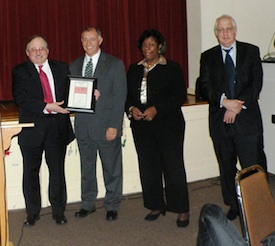
From left: Dennis Frado, Lutheran Office for World Community; Martin Rendon, U.S. Fund for UNICEF; Sullivan Robinson, Trinity Development Corporation and former executive director, Congress of National Black Churches, and Arnold Kohen, international coordinator, Global Priorities Campaign.
Links





Global Priorities: An International Inter-religious Campaign to Change Budget Priorities is working to combat poverty by mobilizing religious as well as secular communities to alter national and global budget priorities. It is vital to find effective ways to change direction. With global military expenditures exceeding $1 trillion annually, reducing unproductive military spending, over and above legitimate self-defense, in poor countries as well as rich ones, can and must be a central component of the battle to eradicate poverty: The equivalent of UNICEF’s annual budget is spent on military purposes roughly every 15 hours, even as one billion children live in almost unimaginable conditions of deprivation. At a time when the world faces the threat of nuclear weapons proliferation, the ongoing struggle against violent extremism and crises in the Middle East and many other places, nations need a road map to human security that reaches beyond military might.
The current focus of Global Priorities is reducing nuclear weapons stockpiles while devoting a portion of the resulting savings to activities to address nuclear nonproliferation, promote child survival, the alleviation of hunger and improve health and education around the world. Global Priorities is facilitating a series of international dialogues leading to a process that builds on elements of a bipartisan resolution, first introduced in the U.S. Congress 2008 by Rep. Jim McGovern (Democrat of Massachusetts) and Rep. Dan Lungren (Republican of California).
The Congressional resolution called for reductions in U.S. and Russian nuclear arsenals that will lead to savings of billions of dollars annually, while directing some of the savings toward increased nuclear security efforts (including new funds to expand and accelerate the Nunn-Lugar Cooperative Threat Reduction Program). The resolution also advocated additional funding to enhance child health and nutrition and improvement of opportunities of children and youth in the world’s poorest countries. Furthermore, the resolution encouraged other nuclear and non-nuclear nations to commit funding for programs that help poor children and youth.
The world is at a crossroads, both in terms of the need to reduce nuclear arsenals and nuclear threats and ensure a better future for its children and people everywhere. Will we seize the opportunity?
Efforts growing out of the Congressional resolution and measures to follow on at the international level can establish a concrete formula for the reduction of nuclear arsenals, thereby playing a significant role in defining our common future. We must bridge the political divisions that exist today to achieve these goals.
A fundamental principle of the Global Priorities Campaign is that human security can be achieved through determined initiatives to eradicate extreme poverty and to realize economic, social and cultural rights. Majority opinion ultimately can be swayed by articulating values whose roots are in every oral and scriptural tradition of the world’s great religious communities: concern for our children, our elders, those living with disabilities, and all the vulnerable members of our societies.
The momentum for the Global Priorities Campaign is growing: the chance to effectively address nuclear dangers at the same time that we generate benefits for children and all others throughout the world must be strongly pursued.
If you or your organization wish to have more information or get involved, please contact:
Arnold Kohen
International Coordinator
Global Priorities Campaign
Address: P.O. Box 32307
Washington, DC 20007 USA
Phone: (301) 585-3229
E -mail: globalpriorities@aol.com
The development phase of the Global Priorities Campaign has been funded by the Ford Foundation, the Connect US Fund as well as religious and humanitarian organizations.